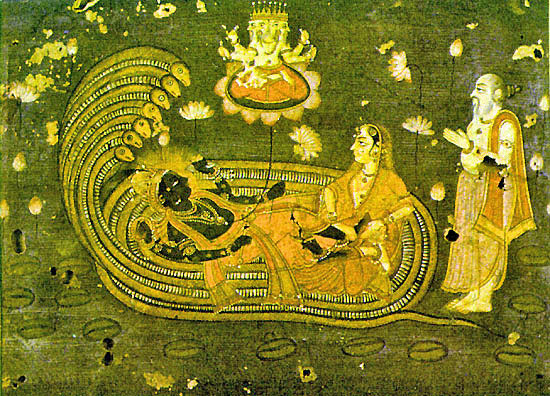
Invocation of Vishnu
Posted: Tue Feb 19, 2008 12:37 am
Original post: simex
In one particular story in the Vishnu Purana, the character Dhruva, intent on seeing The Lord Vishnu, meditates in the forest. Dhruva's meditation is noticed by the gods. Demons and Angels alike descend on Dhruva to prevent him from usurping their power with his super-human meditation. One of them assumes the form of Dhruva's mother and insists that she will kill herself if Dhruva does not stop meditating. Seeing Dhurva's composure in the face of this illusion, the demons make their attempt to deter him.
"Then advanced frightful Rákshasas, wielding terrible arms, and with countenances emitting fiery flame; and nocturnal fiends thronged around the prince, uttering fearful noises, and whirling and tossing their threatening weapons. Hundreds of jackals, from whose mouths gushed flame as they devoured their prey, were howling aloud, to appal the boy, wholly engrossed by meditation. The goblins called out, "Kill him, kill him; cut him to pieces; eat him, eat him;" and monsters, with the faces of lions and camels and crocodiles, roared and yelled with horrible cries, to terrify the prince."
But Dhruva remains steadfast, and eventually Govinda appears to him and offers him a wish. Dhruva wishes to know how he can call on Vishnu; Govinda touches Dhruva with the tip of his conch shell, and immediately Dhruva begins reciting the following invocation of Vishnu:

In one particular story in the Vishnu Purana, the character Dhruva, intent on seeing The Lord Vishnu, meditates in the forest. Dhruva's meditation is noticed by the gods. Demons and Angels alike descend on Dhruva to prevent him from usurping their power with his super-human meditation. One of them assumes the form of Dhruva's mother and insists that she will kill herself if Dhruva does not stop meditating. Seeing Dhurva's composure in the face of this illusion, the demons make their attempt to deter him.
"Then advanced frightful Rákshasas, wielding terrible arms, and with countenances emitting fiery flame; and nocturnal fiends thronged around the prince, uttering fearful noises, and whirling and tossing their threatening weapons. Hundreds of jackals, from whose mouths gushed flame as they devoured their prey, were howling aloud, to appal the boy, wholly engrossed by meditation. The goblins called out, "Kill him, kill him; cut him to pieces; eat him, eat him;" and monsters, with the faces of lions and camels and crocodiles, roared and yelled with horrible cries, to terrify the prince."
But Dhruva remains steadfast, and eventually Govinda appears to him and offers him a wish. Dhruva wishes to know how he can call on Vishnu; Govinda touches Dhruva with the tip of his conch shell, and immediately Dhruva begins reciting the following invocation of Vishnu:
I venerate, him whose forms are earth, water, fire, air, ether, mind, intellect, the first element, primeval nature, and the pure, subtle, all-pervading soul, that surpasses nature. Salutation to that spirit that is void of qualities; that is supreme over all the elements and all the objects of sense, over intellect, over nature and spirit. I have taken refuge with that pure form of thine, oh supreme, which is one with Brahma, which is spirit, which transcends all the world. Salutation to that form which, pervading and supporting all, is designated Brahma, unchangeable, and contemplated by religious sages. Thou art the male with a thousand heads, a thousand eyes, a thousand feet, who traversest the universe, and passest ten inches beyond its contact. Whatever has been, or is to be, that, Purushottama, thou art. From thee sprang Virát, Swarát, Samrát, and Adhipurusha. The lower, and upper, and middle parts of the earth are not independent of thee: from thee is all this universe, all that has been, and that shall be: and all this world is in thee, assuming this universal form. From thee is sacrifice derived, and all oblations, and curds, and ghee, and animals of either class (domestic or wild). From thee the Rig-Veda, the Sáma, the metres of the Vedas, and the Yajur-Véda are born. Horses, and cows having teeth in one jaw only, proceed from thee; and from thee come goats, sheep, deer. Brahmans sprang from thy mouth; warriors from thy arms; Vaisyas from thy thighs; and ŚÃƒÂºdras from thy feet. From thine eyes come the sun; from thine ears, the wind; and from thy mind, the moon: the vital airs from thy central vein; and fire from thy mouth: the sky from thy navel; and heaven from thy head: the regions from thine ears; the earth from thy feet. All this world was derived from thee. As the wide-spreading Nyagrodha tree is compressed in a small seed, so, at the time of dissolution, the whole universe is comprehended in thee as its germ. As the Nyagrodha germinates from the seed, and becomes first a shoot, and then rises into loftiness, so the created world proceeds from thee, and expands into magnitude. As the bark and leaves of the Plantain tree are to be seen in its stem, so thou art the stem of the universe, and all things are visible in thee. The faculties of the intellect, that are the cause of pleasure and of pain, abide in thee as one with all existence; but the sources of pleasure and of pain, singly or blended, do not exist in thee, who art exempt from all qualities. Salutation to thee, the subtle rudiment, which, being single, becomes manifold, Salutation to thee, soul of existent things, identical with the great elements. Thou, imperishable, art beheld in spiritual knowledge as perceptible objects, as nature, as spirit, as the world, as Brahmá, as Manu, by internal contemplation. But thou art in all, the element of all; thou art all, assuming every form; all is from thee, and thou art from thyself. I salute thee, universal soul: glory be to thee. Thou art one with all things: oh lord of all, thou art present in all things. What can I say unto thee? thou knowest all that is in the heart, oh soul of all, sovereign lord of all creatures, origin of all things. Thou, who art all beings, knowest the desires of all creatures. The desire that I cherished has been gratified, lord, by thee: my devotions have been crowned with success, in that I have seen thee.